





Ready To Start Your Journey to Brazil?
Begin your path to Brazilian residency with expert guidance, vetted opportunities, and a transparent step-by-step process.



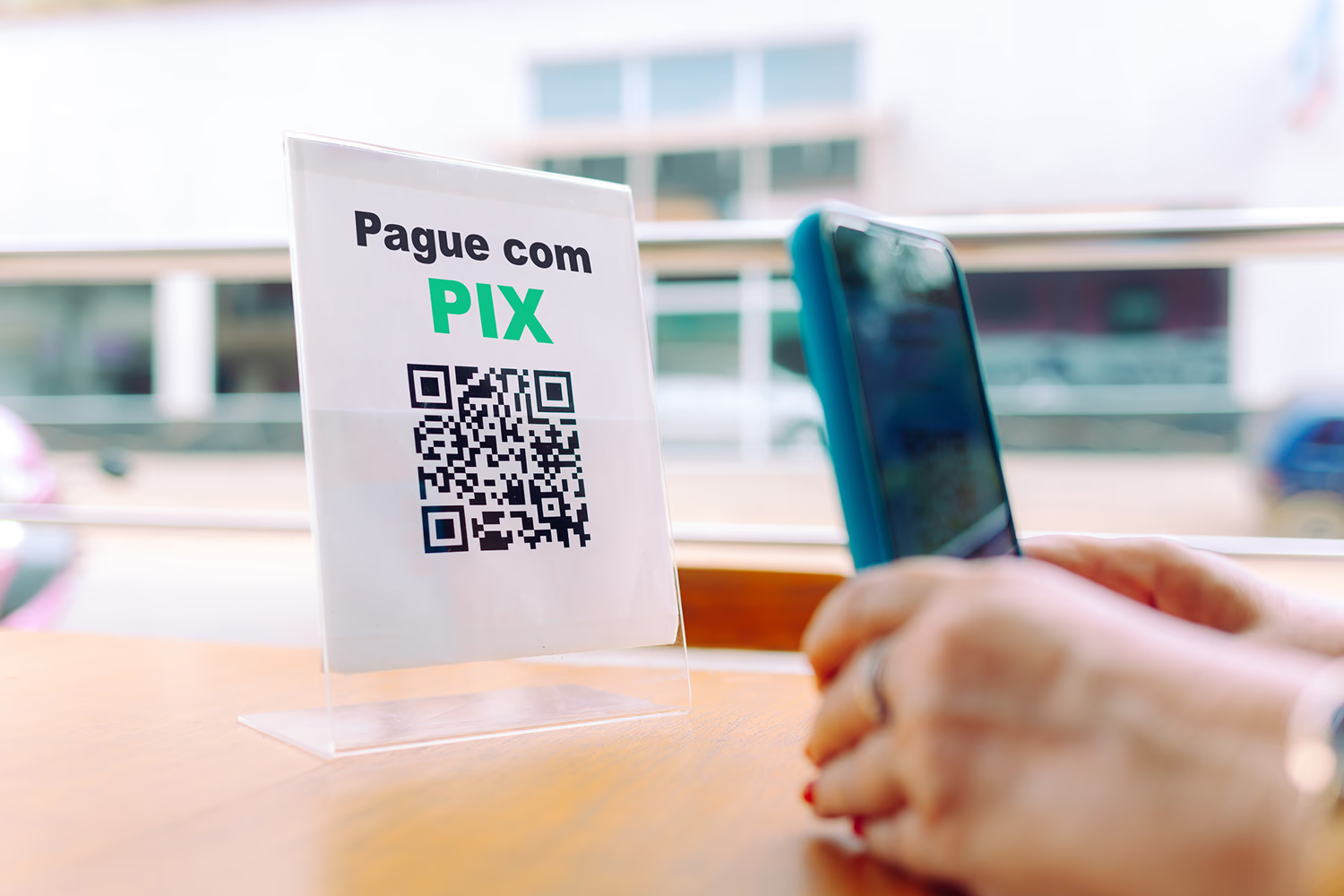
If you're exploring business or investment opportunities in Brazil, understanding PIX isn't optional; it's essential. Here's what you need to know about the payment system that has fundamentally changed how Latin America's largest economy moves money.
Walk into any shop, restaurant, or street market in Brazil today, and the most common question you'll hear isn't "cash or card?"; it's "Tem PIX?" (Do you have PIX?).
PIX is Brazil's government-created instant payment system, launched by the Central Bank of Brazil in November 2020. In just five years, it has become one of the most successful public technology deployments anywhere in the world. Used by over 178 million people, roughly 93% of Brazil's adult population, PIX processes over 6 billion transactions every month and moves approximately R$3 trillion ($557 billion USD) in monthly value. If PIX's monthly flows were a country's GDP, they would exceed the entire economies of Argentina or Chile.
Nobel Prize-winning economist Paul Krugman has argued that Brazil may have invented "the future of money", that PIX delivers what cryptocurrency promoters only ever promised: genuinely low transaction costs and real financial inclusion. It's not hyperbole. In 2019, 43% of Brazilians relied on cash. By 2024, that figure had collapsed to 6%. PIX didn't just digitize payments; it rewired the entire economy.
For foreign investors, entrepreneurs, and anyone considering Brazil's investor and startup residency pathways, PIX isn't a fintech curiosity. It's the infrastructure layer on which modern Brazilian commerce operates.

PIX moves money directly between bank accounts in real time, 24 hours a day, 7 days a week, 365 days a year, including holidays. Transactions settle in seconds.
Every user registers a "PIX key", a unique identifier linked to their bank account. This can be a CPF (individual tax ID), CNPJ (business tax ID), email, phone number, or a randomly generated code. To pay, you open your banking app, scan a merchant's QR code or enter their key, confirm with biometrics or a PIN, and the money arrives instantly.
The critical difference from card payments: PIX bypasses card networks, acquirers, and issuers entirely. It's free for individuals and costs businesses only about 0.33%, compared to 2.34% for credit cards. Settlement is instant rather than the 30-day cycle typical of Brazilian card schemes. There's no separate app to download; if you have a Brazilian bank account, you already have PIX.
For a quick visual overview of how PIX works on the ground, from beach vendors to real estate purchases, we recommend this France 24 report:
As a foreigner in Brazil, you may experience some friction if you are unable to use the PIX systems, as some vendors are sometimes unable to take card or are reluctant to take cash because they've become so accustomed to PIX.
If you've just arrived in Brazil, there is actually an option for you to be able to pay with PIX without being a resident of Brazil and having a bank account. If you have an EU or US bank account, you can download the app Wanderwallet and set up a virtual account that allows you to pay with PIX.
One great benefit of the residency routes we work with is that once you are approved and hold a CRNM (Carteira de Registro Nacional Migratório), the residency card issued to foreign nationals with legal residency in Brazil, you can open a full Brazilian bank account and participate in PIX just like any Brazilian citizen.
This is particularly significant for Americans. U.S. citizens may have heard of FATCA, the compliance requirements that make many foreign banks around the world reluctant to accept American clients at all. Brazil is different. With a valid CRNM and CPF (tax ID), American residents can open accounts at major banks. They do not even ask for your American passport, the ID used is solely the CRNM. The process is straightforward, and once you're in the system, PIX is immediately available.
That means as a foreign investor operating a Brazilian company through a startup or investor visa pathway, you're not locked out of the country's most important financial tool. You can receive payments, pay suppliers, manage payroll, and handle day-to-day finances through the same instant, near-zero-cost infrastructure that 178 million Brazilians rely on every day. It's one of the more tangible ways that Brazilian residency translates into real operational capability.
| Launch date | November 16, 2020 |
| Active users | 178+ million (93% of Brazilian adults) |
| Monthly transactions | 6–7 billion |
| Monthly value | ~R$3 trillion (~$557B USD) |
| Cost for individuals | Free |
| Cost for businesses | ~0.33% |
| E-commerce share (2025) | 42% (surpassing credit cards) |
| Projected e-commerce share (2028) | 50% |
| Cash usage decline | 43% (2019) → 6% (2024) |